Drop & Done
An AI-native reimbursement assistant in the chat apps employees already use. It reads every bill, groups the spend, checks policy, catches duplicates and fake receipts, and asks only the questions it can't answer itself.
Reimbursement is low-value work that everyone pays for
Employees collect bills, type in details, pick categories, check what's allowed and build a claim. Finance then re-checks all of it by hand.
India makes it harder: handwritten auto/taxi slips, faded thermal prints, UPI screenshots in place of invoices, bills in regional languages, and lost GST input credit when hotels don't bill to the company GSTIN.
Three users, one broken loop
👤 Employee
- Hunts for bills in email, WhatsApp and their wallet
- Types every field by hand into a form
- Has to guess the policy rules
- Finds out about a rejection days later
Feels: "chore, unfair delays"
✅ Approver
- Gets 20 claim lines with no context
- Either rubber-stamps them or digs through each one
- Has no signal for what's risky
Feels: "I can't really check this"
🔎 Finance / Audit
- Checks 100% of claims by hand
- Chases missing GSTINs and invoices
- Catches fraud only by sampling
- Has no data on policy leakage
Feels: "drowning in rework"
A large, fast-moving market that still feels form-first
Consolidation: Capital One bought Brex ($5.15B), Ramp passed $1B ARR, Sage bought Fyle. SAP Concur holds about 19% share.
Where incumbents leave room
| Gap | Concur / Zoho / Happay | Drop & Done |
|---|---|---|
| Interface | App + form, one receipt at a time | Chat, whole pile at once |
| Policy check | After submission | Before submission, explained |
| Missing info | Mandatory fields | ≤3 targeted questions |
| Indian bills | Tuned for clean receipts | Handwritten, UPI, Hindi |
| Fake receipts | Emerging add-on | Built in, every claim |
| GST credit | Capture only | Prevent leakage at source |
Drop the pile. Answer two taps. Submit.
🧩 Delhi trip · 21–23 Sep · 9 bills
🧩 Pune day trip · 29 Sep · 3 bills
⚠️ Hotel invoice has no company GSTIN, so we lose ₹1,392 of GST credit. Ask the hotel for a revised invoice?
Yes, draft emailSkip
Yes, client mealJust me, claim ₹1,500
Pile to ready in 0m 35s · 3 questions asked
Submit claimReview lines
Design principles
- Zero forms. The chat is the whole interface.
- Batch first. Handle the whole pile, not one receipt at a time.
- Ask by exception. Only gaps that block submission; tap to answer.
- Explain every flag. Say what's wrong, why, and how to fix it.
- Always show status. ✅ complete · ⚠️ needs info · 🚩 questionable
North-star UX metric
Time-to-ready-to-submit
Target under 2 min for a 10-receipt trip, against about 20 min today.
Where AI does the work, and where rules keep it honest
Human in the loop by design: AI prepares and flags, people approve payouts. Every AI decision is logged with the image region and policy clause it relied on.
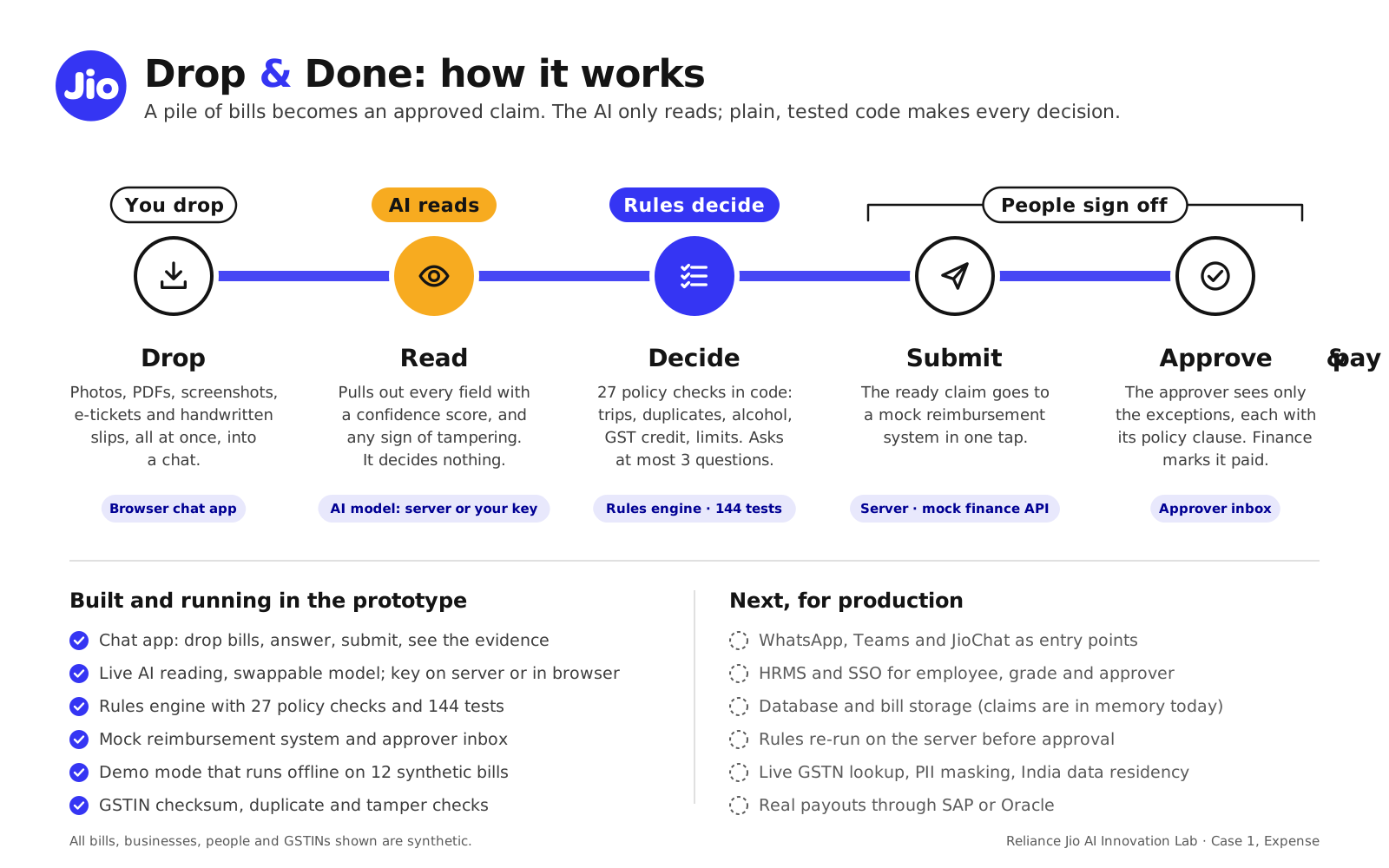
A claim is a state machine, not a form
Each extracted field carries evidence
"amount":  { "value": 4200,
             "confidence": 0.97,
             "source": "bottom-right total" },
"gstin":   { "value": null,
             "confidence": 0.0,
             "status": "MISSING" },
"category":{ "value": "Meals",
             "confidence": 0.88 }
Confidence ≥ 0.85 is auto-filled. Below that, or missing, it becomes a question. Anything contradictory is flagged.
Line states
COMPLETE NEEDS_INFO QUESTIONABLE EXCLUDED
Claim lifecycle
DRAFT → READY → SUBMITTED → APPROVED → PAID
A claim is READY only when every line is COMPLETE or EXCLUDED.
Category checklists
🏨 Hotel: invoice, stay dates, GSTIN, city tier
🍽 Meal > cap: attendees + purpose
🚕 Cab: from/to or trip link
✈️ Flight: boarding pass or e-ticket
Measurable value across time, money and risk
Illustrative model: 10,000 claim-filing employees × 2 claims/month = 240,000 claims/year. Assumptions are listed so they can be replaced with real figures.
| Lever | Today | With Drop & Done | Annual value |
|---|---|---|---|
| Employee prep time | 20 min | 3 min | 68,000 hrs |
| Rework rate | 19% | <5% | 10,000 hrs |
| Finance check / claim | 10 min, all claims | 3 min, risk-based | 28,000 hrs |
| Reimbursement cycle | 10–15 days | 2–3 days | Employee experience |
| GST input credit | Partly captured | Leakage prevented | ₹ direct recovery |
| Duplicates / fakes | Sampled | 100% screened | Loss avoided |
Plus hard savings: GST credit recovered on hotel and travel invoices, and duplicate or fake claims stopped before payout. At ~1% of claims flagged as suspect, even a fraction prevented covers the run cost.
Benchmarks: GBTA (time, error rate) · AppZen / SAP Concur (fake receipt prevalence)
KPIs measured from day one
Experience
- Time-to-ready-to-submit (median)
- Questions asked per claim (target ≤ 2)
- Employee CSAT / NPS
- Days from spend to payout
AI quality
- Field extraction accuracy (labelled eval set)
- % fields auto-filled without edits
- Duplicate precision and recall
- Confidence calibration
Business
- First-pass approval rate
- Finance hours per 1,000 claims
- GST credit recovered (₹)
- Suspect ₹ blocked before payout
Pilot success criteria (8 weeks, one business unit)
Start narrow, prove value, then scale
Phase 1 · Prototype
Now
- Web chat with drag-and-drop pile
- Claude extraction + confidence
- Grouping, policy, duplicates
- Mock reimbursement API
Phase 2 · Pilot
+8 weeks
- Teams / WhatsApp channel
- HRMS + SSO integration
- Approver copilot
- GST recovery + fake-receipt signals
Phase 3 · Scale
+6 months
- SAP / finance system integration
- Card + UPI feed, zero-touch capture
- Cross-employee duplicate detection
- Spend analytics for finance
| Risk | Mitigation |
|---|---|
| Extraction errors on poor images | Confidence thresholds; ask instead of guess; deterministic arithmetic checks |
| Data privacy (PII, bank data) | PII masking before LLM, India data residency, encryption, RBAC, audit log |
| Over-trusting AI decisions | AI never approves payouts; every flag cites evidence; humans override, and overrides feed the eval set |
Let employees drop their bills,
and let AI do the paperwork.
1 · Live demo
12 messy bills to a ready claim, timed live
2 · Pilot BU
One business unit, 8 weeks, measured against KPIs
3 · Sponsors
Finance policy owner + IT security partner